The gap between enjoying a fast online first aid certification classes presentation and taking care of a genuine emergency situation is large. I have actually seen calmness, capable people ice up when a coworker falls down, and I Ringwood first aid course have watched others move with clear function because they had actually been drilled correctly. That distinction seldom comes down to character. It comes from the right first aid training, practiced enough to become muscle mass memory, and updated frequently enough to be Look at this website appropriate. First Aid Pro and similar providers develop programs that shut that void, not by making people professionals in everything, but by straightening first aid actions with exactly how emergency situations really unfold.
What specialists instruct that do it yourself video clips do n'thtmlplcehlder 4end. The web can show you how to do CPR in under five mins. What it can not provide you is the feeling of an appropriately clinically depressed upper body, the resistance of ribs, the decision-making structure when the individual on the flooring is your colleague and the room really feels also tiny. A professional first aid course translates standards right into repeatable actions under anxiety. It is not just skill procurement, it is anxiety inoculation. In great classes, instructors stage messy, imperfect circumstances. A youngster who will certainly not stop vomiting. A diabetic that is lucid one minute and slurring the following. A bystander who shouts advice that disputes with what you were taught. You obtain trained not just on the method, however on sequencing, focusing on, and communicating. That context is what makes first aid and CPR usable beyond the serene boundaries of a video. Anatomy of a strong first aid training program
Every supplier asserts evidence-based training. The difference receives exactly how the day is structured, what is stressed, and how the program is adapted to the participants. First Aid Pro layouts around 4 pillars: relevance, realism, repetition, and recognition.
Relevance appears evident, but it calls for curation. A building team does not require the exact same emphasis as a childcare facility. The most effective trainers interview organisers ahead of time and readjust the equilibrium. Even more time on crush injuries on one website, much more on anaphylaxis and choking for another. They likewise extract facts. Remembering every melt classification seldom assists. Understanding whether to cool down the shed for 20 minutes with running water, safeguard the location, and avoid ointments or ice does.
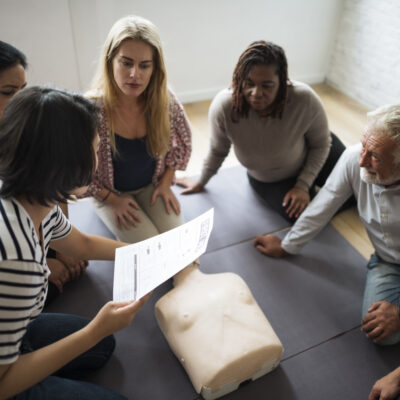
Realism means hands-on time on the floor, not simply sanitised drills. You practice with adult, child, and infant manikins. You learn to apply a tourniquet with handwear covers that feel too huge and fingers that feel too sluggish. You get comments when you wander toward unsafe improvisation. In a strong program, also the role-playing has appearance. A mock casualty may be slightly combative after a head knock. You learn to safeguard the spinal column without getting dragged right into a fumbling match.
Repetition constructs the neural grooves you depend on when your heart is kicking. Ten proper compressions really feel various from a hundred. The second hour you perform CPR, you stop considering where to position your hands. With an AED, the act of transforming it on, peeling the pads, and following the prompts comes to be automated. Trainees usually undervalue how much repetition is required. Professional training courses ensure you obtain it.
Recognition is twofold. Initially, pattern acknowledgment. Is this fainting or stroke? Bronchial asthma or anaphylaxis? The beginning moves overlap, however a proper read conserves minutes that matter. Second, official recognition in the form of a first aid certificate. Certification is not vanity. Several work environments require a first aid and CPR course to fulfill legal responsibilities. A lot more notably, genuine certificates signal that your training aligns with present resuscitation council guidelines and that you passed an analyzed useful component.
The useful core: CPR done to common, not to memory
CPR is the core around which most first aid courses are built. In a CPR course with an experienced trainer, tiny information obtain tuned that rarely register theoretically. Trainees learn to go for a tempo near 100 to 120 compressions per min, but rather than counting to 30 in their head, they sync to a beat. Some instructors use a metronome. Others make use of a song that hits the best tempo. The point is not musical facts, it is reliable pace control.
Depth is corrected by feeling and by responses tools. As well superficial and you distribute absolutely nothing. Too deep on a small adult and you run the risk of injury. Modern manikins with responses inform you if you are hitting 5 to 6 centimeters on an adult. A seasoned trainer will likewise see your shoulder position and describe exactly how to protect your own back. You can not aid if you injure on your own mid-rescue.
Ventilations are shown pragmatically. If you are educated and willing, you supply 2 breaths after 30 compressions. You discover to produce a seal, lift the chin, and watch for chest increase. If you can not get a seal or you do not have a barrier gadget, you maintain compressing. That judgment, showed without dogma, reflects existing support in numerous regions and appreciates real-world constraints.
AED integration often endures in community training. First Aid Pro trainers run drills that interleave compressions with rapid AED setup to ensure that hands-off time stays under 10 secs whenever feasible. You exercise ripping the pads off the plastic while somebody else continues compressions, then clear the upper body at the timely and return to promptly after a shock. That choreography is what modifications outcomes.
The parts of first aid people typically obtain wrong
First-time learners fixate on the dramatic skills. They wish to quit major bleeding or open up a respiratory tract. Instructors recognize the traps that create troubles later.
Calling for assistance is one. People undervalue the moment it requires to situate a phone, unlock it, and navigate to an emergency situation number under tension. Great programs choreograph the phone call. Assign it. Validate it took place. If the building has a security desk or emergency response group, understand the quickest path to them and the simplest means to state where you are. I still keep in mind a circumstance in a warehouse where students maintained shouting a person phone call 000 without realizing they were the just one in the aisle.
Scene safety is one more. Hurrying towards a broken down individual near an online forklift lane or a roadway brink prevails in scenarios. Instructors stop the drill and reset. The lesson lands harder than a paragraph in a manual.
Finally, recovery placements and tracking frequently go sloppy. Rolling a vomiting person onto their side while securing the head can be learned quickly, but the follow-through is seeing breathing closely, not walking away because the terrifying part mores than. Trainees are advised that many emergencies unfold over 10 to thirty minutes. Peace of mind, warmth, and recurring evaluation become part of first aid, not aftercare.
Why updates and refreshers matter
Guidelines do not change for sport. They change when new proof clears up what works. Compression-only CPR ended up being much more accepted for untrained rescuers because information revealed that hard, quick compressions are far better than fumbling breaths. Tourniquet use changed from last option to earlier factor to consider for severe limb bleeding in several settings when civilian-grade tools revealed security in trained hands. Courses that matter keep pace, therefore must you.
A solid rhythm is to book a CPR refresher course every 12 months and a full first aid course every 2 to 3 years, or more often if your function requires it. The muscle memory softens faster than you assume. I have watched qualified staff boost noticeably by the 3rd or 4th situation in a refresher, merely due to the fact that their bodies bore in mind exactly how it ought to feel.
Customising first aid and CPR courses to the genuine risk
The very same list does not relate to every group. When I collaborate with a senior high school, we drill on sports injuries, asthma, anaphylaxis, and fundamental spinal care. In a business cooking area, we hang around on burns, lacerations, and chemical exposures from cleaning up agents. A workplace with a lot of public foot website traffic practices passing out protocols, diabetic person lows, and stroke recognition, consisting of a strategy to fulfill paramedics at the elevator.
It is not simply web content, yet logistics. Where is the AED, and just how fast can you retrieve it? In a huge location, the distinction between a 90-second and a 4-minute access is often whether the device is placed centrally and well-signed. Some teams map the AED and rehearse the course. They time it. That enters into the training day.
Assessment that seems like practice, not performance
Good analysis does not attempt to deceive you. It produces sufficient unpredictability that you are forced to believe and enough framework that you can apply what you found out. In a First Aid Pro class, a common situation may start with a flattened grownup in a stairwell. You listen to agonal gasps. The teacher looks for three things prior to you touch the individual: that you look for hazards, that you send out for assistance and AED, which you evaluate responsiveness and breathing promptly and properly. Just after that do compressions begin. You are racked up not simply on the technical activities however on sequencing, clearness of commands, and efficient delegation.
Paper examinations still show up, typically several option. They exist to capture misunderstandings that abilities method could conceal. The conversations around wrong solutions are where discovering deepens. As an example, many individuals misremember the proper proportion of compressions to breaths for 2 rescuers with a baby. Chatting it through cements it much more than guessing an option.
Pieces of gear worth understanding well
You will certainly not end up being a paramedic in a one-day first aid course, however you can end up being skillful with a few devices that increase your effectiveness.
Bag-valve masks turn up in some programs, but also for a lot of work environments, pocket masks with one-way shutoffs or resuscitation keyrings are extra practical. You learn where to keep them so they are reachable within seconds.
AEDs vary. Some units are fully automatic, providing a shock without you pressing a button. Others require confirmation. Pads vary in placement overviews. Getting aware of the certain design in your building saves fumbles later. I advise teams to open the AED, power it on briefly, and pay attention to the voice prompts throughout training. A lot of units have training settings to prevent accidental shocks.
Tourniquets are straightforward with method, and dangerous without it. The technique is not hard, yet people frequently quit turning too early when the discomfort reaction from the casualty is strong. Trainers show you to tighten till bleeding stops, after that secure the windlass. Mark the moment. Reassess. You do not cover the tourniquet or loosen it. That degree of clarity reduces second-guessing in the warm of the moment.
Epinephrine auto-injectors are lifesavers in anaphylaxis. Programs educate acknowledgment, approval, injection through clothes when essential, and post-administration monitoring, including the truth that signs and symptoms can rebound and that a 2nd device may be needed if the rescue is delayed.
Glucose gels or quick resources of sugar are covered for hypoglycemia in recognized diabetics that are conscious and can ingest. This is where nuance issues. Instructors stress what not to do as high as what to do. You do not provide anything by mouth to somebody drowsy or throwing up. You handle respiratory tract and call for help.
The subtle abilities: interaction and management in tiny moments
First help is a team sporting activity, despite strangers. The ability to offer straightforward, direct guidelines under pressure beats expensive strategy. In circumstances, instructors commonly trainer trainees to speak simply put, clear lines: You, in heaven shirt, call 000 and request for a rescue. Tell them we have an adult, not breathing typically, suspected heart attack. Bring the AED from reception. That uniqueness protects against diffusion of duty. It additionally relaxes bystanders who want to help but do not know how.
You likewise find out to manage the room. Create a bubble for the casualty. Position a person at the door to reroute foot web traffic. Ask an associate to bring a covering or layer to avoid hypothermia after hemorrhaging or shock. These are not extravagant moves. They are the scaffold that maintains the primary intervention clean.
Documentation matters once the paramedics take control of. A good first aid course shows you exactly how to turn over succinctly. Age or estimated age, what you saw, what you did, times if recognized, any kind of medications made use of, any kind of allergic reactions mentioned, and whether there was head injury. I keep a mental layout since that discussion typically happens with adrenaline still high.

Choosing a supplier without guesswork
Not all first aid courses are created equivalent. You do not need to end up being a certification expert, however you must feel comfy asking sharp questions prior to booking.
- Is the program across the country acknowledged or aligned with the relevant resuscitation council standards, and will I get a first aid certificate upon effective completion? How much hands-on time will certainly I get with adult, kid, and baby manikins, and do you make use of feedback devices for CPR deepness and rate? Do you adapt situations to our office threats, and can we present training in our environment to practice AED retrieval and interaction paths? What are your trainers' histories, and exactly how just recently have they rejuvenated their own qualifications? How is analysis carried out, and what assistance do you attend to CPR refresher course scheduling?
You will see none of those questions request for most affordable cost. Expense issues, but worth lives in realistic look and repeating, not in a plastic card.
The value of blended discovering done right
Many suppliers, consisting of First Aid Pro, provide mixed training courses where concept is completed online before the sensible session. When carried out appropriately, this model is efficient. You soak up anatomy, legal ideas, and risk identification at your rate, after that spend classroom time virtually totally on drills. The catch is when on the internet components are bloated or when useful sessions are hurried because the schedule assumes theory changed method. When you see a four-hour home window promoted for a complete first aid and CPR course with a dozen individuals, inquiry whether you will obtain enough flooring time.
A good mixed version appears like this: two to 4 hours of engaging online content with short quizzes, after that a sensible block where the teacher focuses on skills, scenarios, and evaluation. You still sweat. You still repeat till it clicks. The advantage is that discussions are sharper due to the fact that everybody arrives with the same baseline theory.
What adjustments as soon as your team is trained
Training is not an end state. It activates various other small, compound adjustments that raise safety and security. After a First Aid Pro session, numerous workplaces quietly rearrange their atmosphere. The AED gets relocated from a secured closet behind function to a visible wall surface near the main entry with clear signage. First aid sets shed dusty, ended things and include what issues for that certain location: more melt dressings in kitchen areas, even more trauma pads at websites with machinery, child-sized components in schools.
On the human side, teams start recognizing who really feels comfortable as an initial responder, who will certainly deal with the emergency situation phone call, and who will certainly meet paramedics. That pre-assignment smooths real events more than any type of poster on a break space wall surface. I have also seen firms include quarterly five-minute drills. A single person reveals AED run, and a person times the length of time it takes to get to the tool, return, and transform it on. No dramatization, just a regular that maintains the course clear and the muscle mass memory alive.
Real situations that show the difference
A logistic depot that trained 3 weeks previously had a vehicle driver collapse near the loading anchors. A coworker heard agonal gasps and did not blunder them for typical breathing due to the fact that they had exercised that sound in class. She sent out a runner for the AED, started compressions within 30 secs, and passed the telephone call manuscript to another person who was already dialing. The AED arrived at the two-minute mark. A shock was advised and delivered. The chauffeur survived to release. Debriefing later on, the group concurred that the decisive aspect was not just courage. It was that they had practiced the specific choreography on the same concrete floor.
At a main institution after a first aid and CPR training day, a trainee with a well-known peanut allergic reaction started to wheeze and created hives throughout lunch. A teacher acknowledged the indications early, made use of the student's epinephrine auto-injector within mins, and had the front office call a rescue and inform moms and dads with details language. The youngster maintained before paramedics arrived. Without training, the delay might have stretched long enough to complicate the response.
These are not cinematic rescues. They are ordinary individuals doing normal points correctly and promptly. That is the goal.

The limitations of first aid, mentioned plainly
No training course can transform you right into medical team. There are limits that you must appreciate. You do not administer medications aside from those allowed in your jurisdiction and within your training. You do not diagnose. You deal with life dangers you can recognize and stop damage. You turn over to professionals with a clean, clear recap and the self-confidence that you did the fundamentals well. Excellent training teaches humbleness together with skill. It keeps you from overreaching and reminds you that often one of the most important step is resting with someone, maintaining them warm and tranquil while seeing their breathing.
A useful course forward
If you manage a group or merely intend to work when it counts, right here is a workable technique that stabilizes ambition with reality.
- Book a First Aid Pro first aid course that includes CPR training. If you are time-poor, consider combined distribution, but focus on a supplier that ensures significant hands-on practice. Map your room. Know the AED area, the quickest path for paramedics, and any threats that would reduce or jeopardize an action. Readjust signage if it is unclear. Schedule a CPR refresher course within year. Add short internal drills, like AED retrieval runs, to sustain confidence between official training. Update first aid sets to reflect actual dangers. Establish a reminder to examine expiration days quarterly. Supply kid or infant products if your setting warrants them. Identify duties during an event. Concur who will certainly call, that will lead the scene, and that will meet responders. Create it down where individuals can discover it under stress.
The throughline in all of this is respect for reality. Emergencies are short in a timely manner, messy, and full of noise. Specialist first aid courses do not get rid of the worry, but they instruct you to relocate anyhow, with actions that make a distinction: inspect the scene, phone call for aid, begin the ideal activities, and keep going until a person with an attire and a stretcher takes control of. That is the assurance of appropriate first aid training, and it is one pledge worth cashing in before the day you need it.